
Rebar couplers
HRC Europe´s rebar couplers are high-performance mechanical splice solutions for projects where reinforcement continuity, capacity and on-site reliability are critical. The HRC400 Series reinforcement couplers create a splice stronger than the rebar, allowing the reinforcement to develop its full strength and ductility while reducing congestion, saving rebar length and avoiding protruding bars in casting joints.
Need help choosing the HRC solution for your project?
Products
Advantages of HRC Europe´s Rebar couplers


What is a rebar coupler?
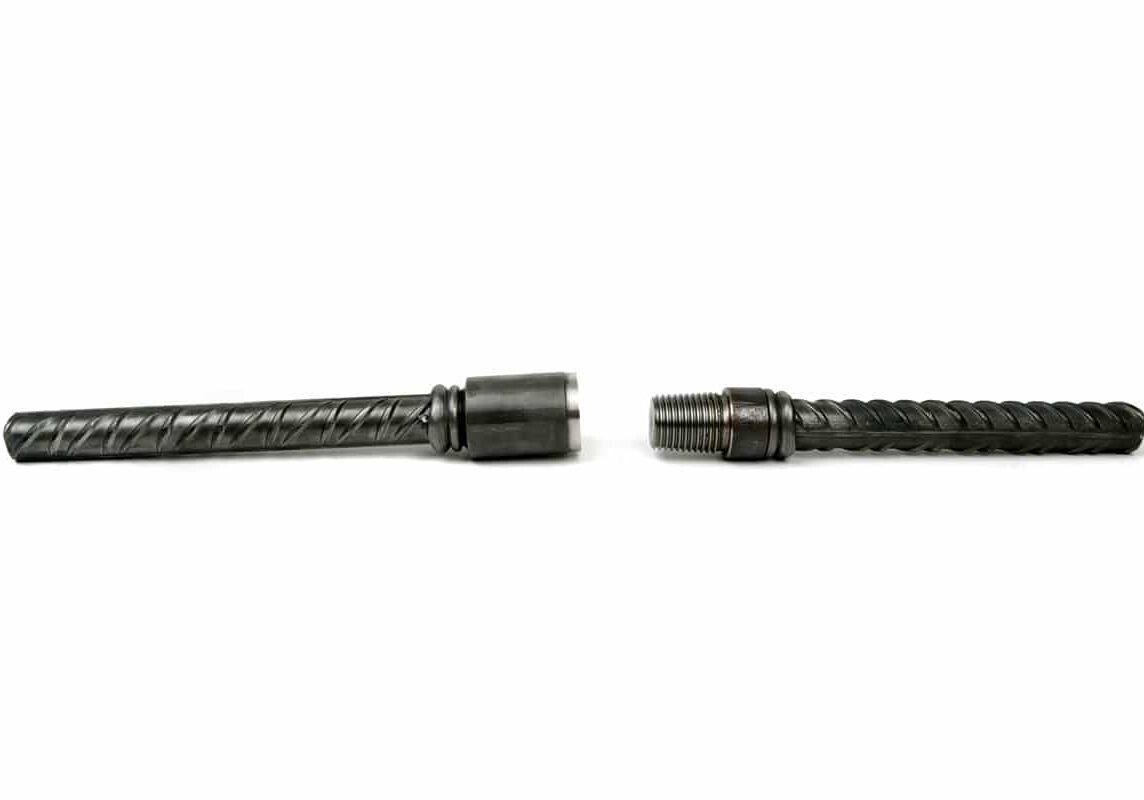
Rebar couplers are components used to connect two reinforcing bars in the longitudinal direction, forming a mechanical splice. They provide an alternative to lap splices or welded connections.
Mechanical splices are often used to avoid protruding bars in casting joints, reduce congestion in confined spaces and save rebar length. This can make reinforcement detailing more compact and improve practical handling on site.
Reinforcing bar couplers can be manufactured and attached to the rebar using different technologies. As a result, they may differ in tensile capacity, robustness under real site conditions, ease of assembly and how easily correct installation can be verified. These characteristics should be considered when choosing the right rebar coupler for a project.
HRC400 Rebar Couplers
HRC400 rebar couplers are developed to meet the highest performance requirements for mechanical splicing. The coupler creates a splice that is stronger than the rebar itself, helping ensure that the reinforcement can develop its full capacity without the splice becoming the weak link.
This makes HRC400 a high-performance reinforcement coupler solution for projects where capacity, reliability and robust installation are essential.
The HRC400 Series:
- Transfers the full strength and strain capacity of the rebar, allowing the rebar to develop its full ductility — with a result comparable to an unspliced bar
- Improves design flexibility, as all couplers can be placed in the same section
This structural performance is combined with a user-friendly design. Correct installation is crucial for the performance of any mechanical splice, and HRC400 is developed to support reliable assembly and control on site.
Advantages offered by HRC400 Series rebar couplers
- Exceed all known international requirements for rebar couplers, including reinforcement design specifications for seismic events
- Designed to exceed the actual stress and strain capacity of all reinforcement grades, independent of natural variations between individual steel heats
- Behave like continuous reinforcement and allow full utilisation of the actual strength and strain properties of the reinforcement, without limiting the usable ductility of the reinforcement
- Allow all bars to be spliced in one section, with no need to stagger the couplers
- Female and male parts are machined as separate components. This results in consistently high splice performance, including very small slip, independent of natural variations in rebar shape and rib pattern
HRC400 Series rebar couplers are designed for fast, reliable and straightforward installation on site.
- Tapered threads provide fast and easy installation:
- Self-centering
- Self-locking
- Fewer turns are needed for full assembly compared to parallel threads
- Coarse threads are less sensitive to tolerances and rough site conditions
- Always delivered with thread protection; nail-on flange available on request
-
- Coarse threads are less sensitive to tolerances and rough site conditions
- Always delivered with thread protection; nail-on flange available on request
- Quality Control is straightforward and reliable through visual inspection
is straightforward and reliable through visual inspection
HRC400 Series – tested and documented high performance
HRC400 rebar couplers are certified by Kontrollrådet, a Norwegian notified body, according to ISO 15835 for categories B, F and S. The products are also covered by an ETA and carry the CE marking.
The HRC400 Series also fulfils the technical requirements of other European standards and certification schemes, including:
- BS 8597 (UK)
- "DIBt: Grundsätze für Zulassungs- und Überwachungsprüfungen von mechanischen Betonstahlverbindungen" (Germany)
- Kiwa BRL 0504 (The Netherlands)
- NF A35-020 (France)
- BY4B (Finland)
- "Boverkets handbok om betongkonstruktioner - BBK” (Sweden).
Fulfilment of the applicable requirements can be documented directly through existing certifications and test results. Tensile tests consistently result in rupture of the parent rebar. This shows that the coupler does not limit the capacity of the connection, regardless of the actual rebar strength, with ultimate tensile stresses above 700 MPa.
| Technical aspect | HRC400 Series performance |
| Strength | Rm,act - (full actual rebar strength) |
| Ductility | Agt,act - (full actual elongation) |
| Slip | ≤ 0,10mm |
| Fatigue | Fulfils the requirements (+ S/N-curve) |
| Seismic performance | Fulfils the requirements |
In addition to standard criteria such as slip, tensile strength, seismic performance and fatigue performance, HRC400 Series rebar couplers have been successfully tested at low temperatures down to -40 °C.

General
A rebar coupler (also called a mechanical splice) is a mechanical device used to connect two reinforcing bars end-to-end, allowing them to behave as a continuous reinforcement element without overlapping.
Rebar couplers are used to eliminate lap splices, reduce material use and reinforcement congestion, improve structural performance, and simplify installation. They can also replace protruding bars at casting joints, improving safety on site.
Couplers are commonly used in all types of structures, particularly in:
- Heavily reinforced or congested zones
- Seismic applications
- Applications involving modular formwork systems
The basic types are:
- Standard couplers (one bar must be rotated to close the splice)
- Position couplers (for bars that cannot be rotated or for bent bars; only the sleeve is rotated)
- Transition couplers (for connecting bars of different diameters)
Couplers can also be classified according to their load-transfer principle:
- Threaded couplers
- Grouted couplers
- Bolt-lock couplers
The HRC400 system consists of standard couplers (HRC410/420) for rebar diameters of 12–40 mm and position couplers (HRC410/490) for rebar sizes of 25–40 mm. All couplers are based on coarse tapered threads. These threads enable fast installation and require fewer turns during assembly than parallel threads. They also allow for easy and reliable verification of correct installation.
Selection depends on:
- Structural performance requirements: Not all rebar couplers fulfil all requirements, so check the declared product performance against the applicable requirements.
- Site conditions, accessibility, and geometrical constraints: For example, can the bars rotate? Is there sufficient space for assembly tools? Position couplers are longer than standard couplers, while bolt-lock-type couplers often have larger diameters than threaded couplers.
- Availability: Check availability for the required bar diameter and type.
HRC400 fulfils known requirements. HRC410/420 standard couplers can be installed without a prescribed torque.
Typical situations include:
- Areas with congested reinforcement
- Limited space for the required lap length
- Large-diameter bars requiring impractically long lap lengths
- Precast or staged construction
- Safety considerations, such as avoiding protruding bars at casting joints
- Use of formwork systems or modules where boring through the formwork should be avoided
For small repairs and the closing of openings, engineers often consider using couplers instead of simpler solutions such as lap splicing. When their use is planned in advance, rebar couplers can improve the efficiency and safety of the construction process.
Yes, rebar couplers are widely used but can be more expensive than lap splicing. Their use is therefore typically driven by technical necessity or practical and safety considerations rather than by product cost alone.
No. Rebar coupler components from different producers or product systems cannot be interchanged or combined.
Rebar couplers are developed, tested, and certified as systems with dedicated components. Combining components from different brands or producers creates the following issues:
- Installation: Do the threads fit? Which installation guidance should be followed?
- Capacity and performance: The capacity and performance are unclear when components from two different producers are used.
- Documentation: No certification covers the use of parts from two different manufacturers.
- Responsibility: Who has product responsibility if the splice is made with components from two different producers?
Most importantly, there is a risk of creating a weakness in the structure.
This means that the choice of rebar coupler systems needs to be coordinated, especially in projects with construction stages and interfaces realised by different contractors.
Projects with Rebar couplers


